
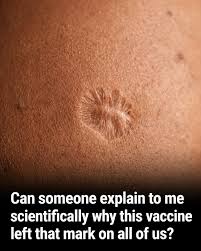

Millions of people around the world still carry the small round scar left by the smallpox vaccine, and many have wondered why this vaccine marked the skin while most modern vaccines do not. The reason comes down to how the vaccine was given and how the body reacted to it.
Unlike today’s vaccines, which are usually injected deep into the muscle with a single needle, the smallpox vaccine was applied using a special two-pronged needle that repeatedly punctured the surface of the skin. Doctors made several quick pricks in the upper layer of the arm, allowing the vaccine virus to enter the skin tissue.
This method triggered a strong local immune reaction. Within a few days, a small bump appeared, which later turned into a blister filled with fluid. The area then formed a scab as the immune system fought the weakened virus and learned how to protect the body against smallpox.
Because the vaccine created a visible wound on the skin’s surface, the healing process often produced permanent scar tissue. That is why so many vaccinated people were left with the famous circular mark on their upper arm.
For generations in countries like United States and United Kingdom, the scar became a lifelong reminder of one of medicine’s greatest achievements. Smallpox was once among the world’s fatal diseases, killing millions of people throughout history. Thanks to worldwide vaccination efforts, the disease was officially declared eradicated in 1980, making smallpox the first human disease ever completely eliminated.

