
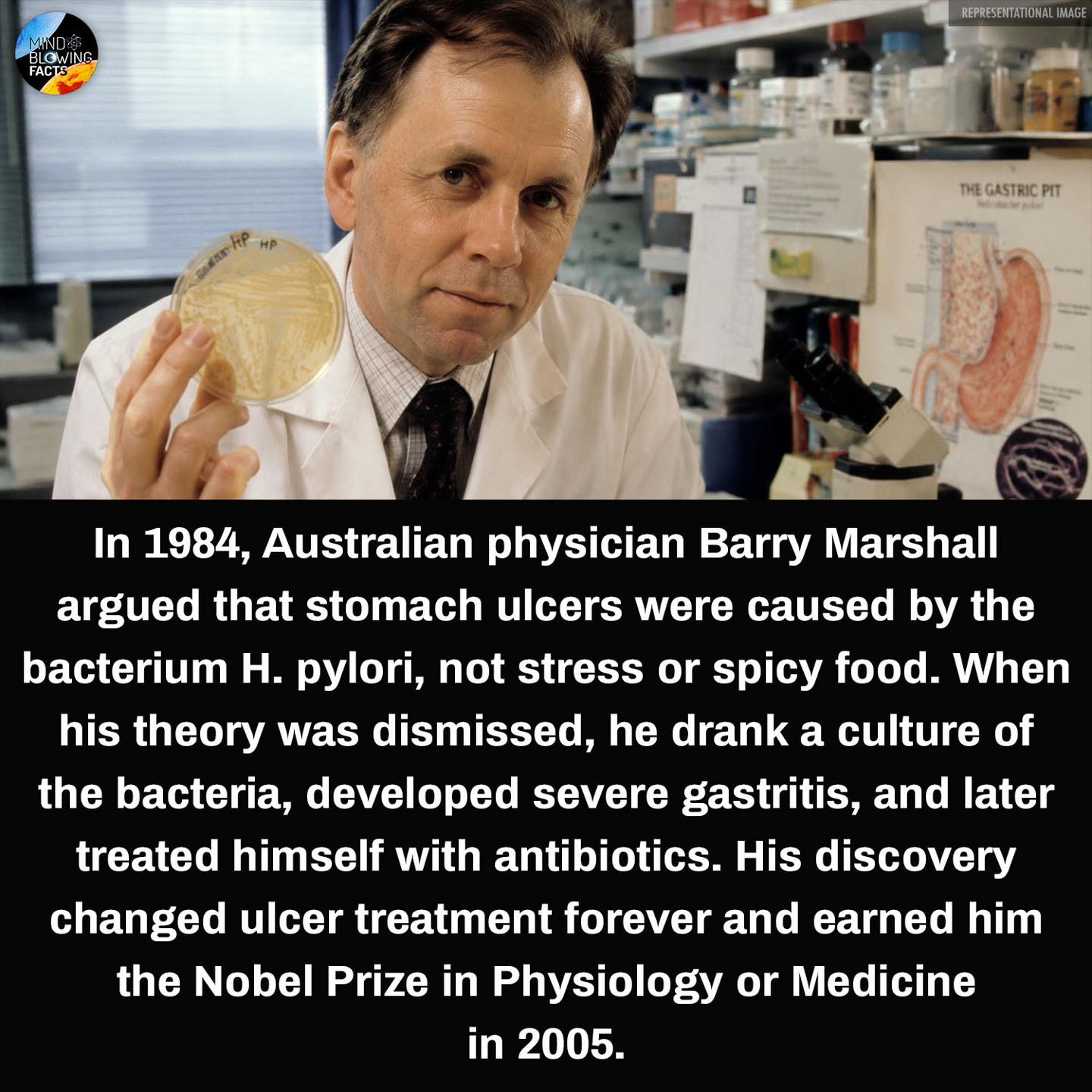

In 1984, Australian physician Barry Marshall was trying to prove something the medical world did not want to believe: stomach ulcers were not just caused by stress, spicy food, or too much acid — they were often linked to a bacterium called Helicobacter pylori. At the time, the idea sounded almost impossible to many doctors, because the stomach was considered too acidic for bacteria to survive there. But Marshall and pathologist Robin Warren kept finding the same organism in patients with gastritis and ulcers, and Marshall became so determined to prove the connection that he used himself as the test subject. He drank a culture of H. pylori, became sick with severe gastritis, and then treated himself with antibiotics. The experiment helped change the way doctors understood ulcers forever, shifting treatment away from lifelong antacids and toward antibiotic therapy that could actually target the cause. What began as a rejected theory became one of the most important medical discoveries of the century — and in 2005, Marshall and Warren were awarded the Nobel Prize in Physiology or Medicine. Sometimes changing medicine takes evidence. Sometimes it takes courage. And sometimes, it takes a scientist willing to swallow the proof.
What is he doing today
- The Marshall Centre: He continues to serve as the Director of the Marshall Centre for Infectious Diseases Research and Training at the University of Western Australia (UWA). The centre focuses on cutting-edge diagnostics, genomic analysis, and mapping infectious disease threats.
- Clinical Practice: He maintains his academic appointment as a Professor of Clinical Microbiology at UWA and continues to treat patients at the gastroenterology department of Sir Charles Gairdner Hospital in Perth.
- Global Appointments: Outside of Australia, he holds an ongoing clinical associate professorship at the University of Virginia. Additionally, he is an International Academician of the Chinese Academy of Engineering.
- Expanding Care to Vietnam: In May 2026, Marshall oversaw a major milestone when the UWA Marshall Centre finalized a strategic partnership with Vietnam’s VinMec Healthcare System. Marshall was present for the signing of the agreement, which establishes clinical training and research pipelines to transform how gastric cancers are prevented and diagnosed across Vietnam.
- Beijing Appointment: In March 2025, he traveled to China where he was officially appointed as a Distinguished Professor at the Peking Union Medical College Hospital (PUMCH) to help guide their international medical research programs.
- Noisy Guts Project & Biotech: He continues to lead his medical spin-out company, Noisy Guts Pty Ltd, which develops diagnostic tools and functional foods to treat Irritable Bowel Syndrome (IBS) using acoustic gut-belt technology. He also serves as the director of the biotech startup Ondek, which uses genetically modified H. pylori as a safe platform for new drug and vaccine deliveries.

