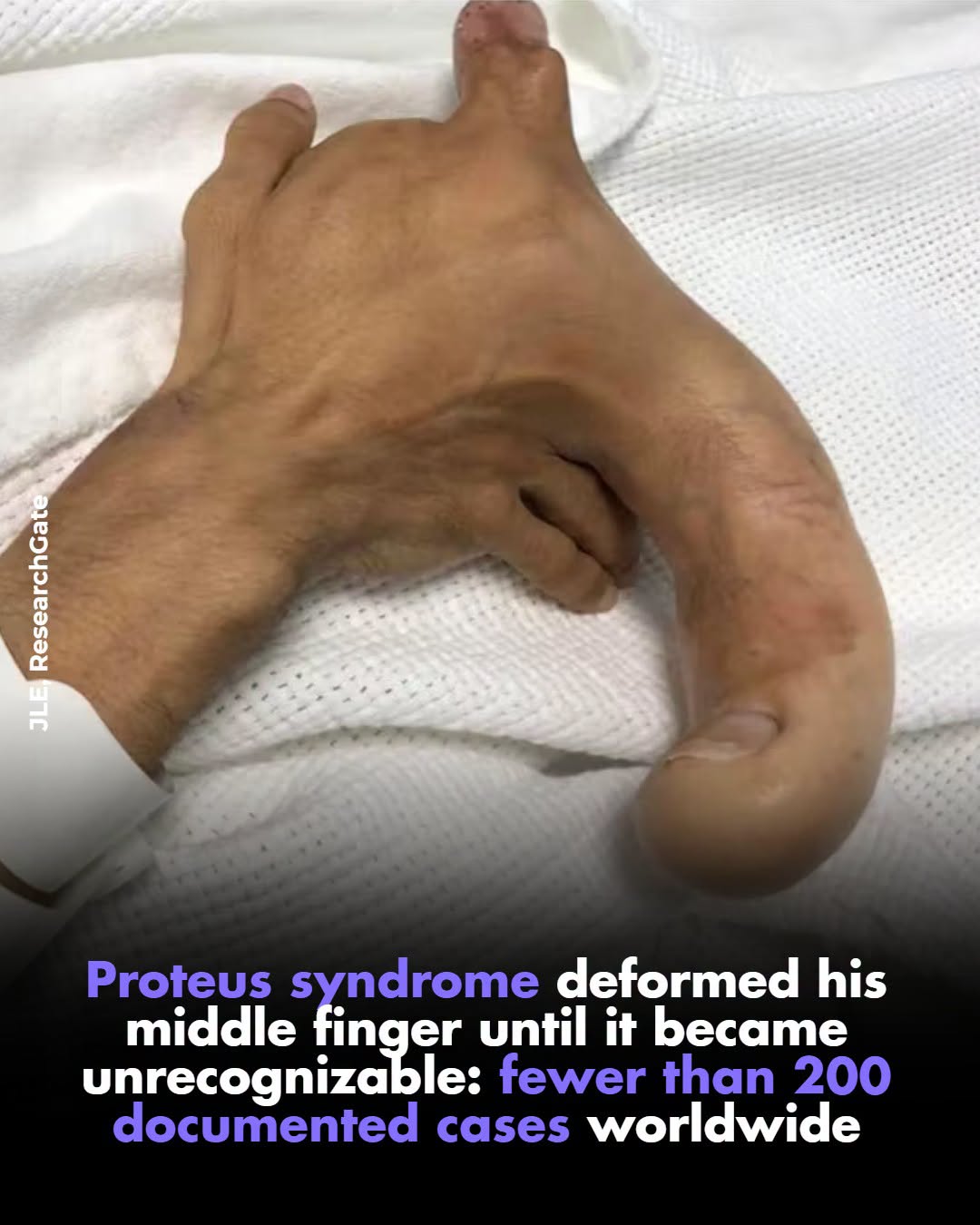

Proteus syndrome gives no warning. It acts in silence, forcing certain tissues in the body to keep growing when they should already have stopped. The result can be such extreme asymmetry that the affected part becomes almost unrecognizable as part of the human body.
In this case, the patient’s middle finger grew to proportions that defy any known anatomical reference. It is not an optical illusion or a digital edit: it is the real manifestation of one of the rarest diseases on the planet. Fewer than two hundred cases have been documented in the entire history of medicine, making each diagnosis almost clinically uncharted territory. The doctors who treat them, in many cases, have never seen another patient like it.
What makes Proteus syndrome especially disturbing is its unpredictability: it does not always affect the same areas or follow a fixed pattern. It can involve bones, skin, blood vessels, or fatty tissue, and it progresses over the course of a lifetime. Faced with a case like this, the medical question that inevitably arises is whether amputation represents a solution or an irreversible loss that only trades one form of limitation for another.
Proteus syndrome is an ultra-rare, progressive genetic condition characterized by the asymmetric, irregular overgrowth of various tissues. This sporadic disorder is caused by a somatic mutation in the AKT1 gene, leading to a mosaic pattern where only some cells in the body are affected. Infants typically show no symptoms at birth, but manifestations rapidly emerge between 6 and 18 months of age and continue to progress throughout childhood. [1, 2, 3, 4, 5]
Signs and Symptoms
The manifestations of Proteus syndrome are typically patchy, asymmetric, and vary wildly from person to person. Major signs include: [1, 2]
- Skeletal Overgrowth: Accelerated bone development causes limbs, fingers, or toes (macrodactyly) to grow to drastically different lengths. Skull and jaw deformations are also common. [1, 2]
- Cerebriform Connective Tissue Nevi (CCTN): Thick, raised, firm skin lesions with deep grooves resembling the surface of a brain. These most commonly develop on the soles of the feet or palms of the hands. [1, 2]
- Fat and Vascular Malformations: Patches of dysregulated fatty tissue, including benign tumors called lipomas, can form alongside localized fat loss. Blood or lymphatic vessel malformations also appear. [1, 2, 3, 4]
- Severe Spinal Curvature: Rapidly progressing scoliosis or kyphoscoliosis that can distort body structure and impair basic mobility. [1, 2]
- Neurological Signs: Intellectual disabilities, seizures, or vision loss, which are sometimes physically marked by distinct facial traits (like a long face or drooping eyelids). [1, 2, 3]
- Life-Threatening Complications: Malformed blood vessels put individuals at a significantly elevated risk for deep vein thrombosis (DVT) and pulmonary embolisms. [1, 2]
Treatment and Management
There is currently no cure for Proteus syndrome. Management is highly individualized, requiring a multidisciplinary medical team coordinated by geneticists, pediatricians, or internists. Treatment focuses on managing active symptoms and preventing life-threatening events: [1, 2, 3, 4, 5]
- Orthopaedic Surgery: Procedures like epiphysiodesis (ablating growth plates to halt linear bone growth) are frequently used to manage limb-length discrepancies and joint distortions. Spinal surgeries may be necessary to correct severe scoliosis.
- Thrombosis Prophylaxis: Due to the high risk of fatal blood clots, aggressive monitoring and preventative antithrombotic medications (blood thinners) are critical, especially prior to any planned surgery.
- Dermatological Care: Large skin lesions can cause functional issues and intense malodour due to microbial colonization in deep skin folds. Laser treatments, custom orthotics, or specialized footwear help preserve mobility and skin integrity.
- Targeted and Symptomatic Therapies: While standard drug treatments are limited, clinical trials studying AKT inhibitors (therapies specifically designed to counter the active genetic mutation) offer emerging pathways to help slow tissue overgrowth.
- Rehabilitation and Psychosocial Support: Ongoing physical and occupational therapy is vital for managing musculoskeletal strain. Because the progressive deformities often carry heavy social stigma, robust psychological counseling is highly recommended for both patients and their families. [1, 2, 3, 4, 5, 6, 7, 8]
there are active and recent clinical trials focusing on targeted molecular therapies for Proteus syndrome. Historically, treatment was purely surgical and palliative. However, recent research has shifted toward targeted AKT inhibitors. These medications directly target the hyperactive AKT1 gene mutation that causes the characteristic tissue overgrowth. [1, 2, 3]
Key Clinical Trials & Breakthroughs
1. Miransertib (MK-7075 / ARQ 092) [1]
Miransertib is a selective AKT inhibitor and the most heavily researched drug for Proteus syndrome. The U.S. FDA has granted it Orphan Drug and Rare Pediatric Disease Designations specifically for this condition. [1, 2]
- The MOSAIC Study (NCT03094832): This landmark Phase 1/2 open-label clinical trial, sponsored in collaboration with institutions like Boston Children’s Hospital, evaluated the safety and tolerability of miransertib in patients with Proteus syndrome and PIK3CA-Related Overgrowth Spectrum (PROS). Finalized data published from the study confirmed that the drug is safe, tolerable, and well-managed in pediatric and adult patients. [1, 2, 3]
- Efficacy Outcomes: Clinical findings indicate that miransertib successfully slows down the growth of abnormal tissues. Patients experienced physical reductions in cerebriform connective tissue nevi (CCTN) on their feet, significant reductions in chronic bone pain, and stabilization of skeletal deformities, resulting in greatly improved joint mobility. [1, 2, 3]
2. Natural History Studies (NCT00001403)
The National Human Genome Research Institute (NHGRI) has hosted long-running natural history trials for Proteus syndrome. While these are not testing a new drug, they are vital observational trials. They track patients over decades to identify specific disease biomarkers, evaluate long-term tissue changes via advanced MRI mapping, and pave the way for future gene-targeting therapies. [1, 2, 3, 4, 5]
Who is Eligible?
While eligibility varies by specific trial protocols, standard inclusion criteria for Proteus syndrome drug trials generally require: [1, 2, 3, 4]
- A confirmed genetic mutation of the somatic AKT1 gene (proven via a skin or tissue biopsy).
- Evidence of progressive disease progression or worsening symptoms within the last 12 months.
- Participants are usually 2 years of age or older. [1]
How to Find and Join a Trial
Because Proteus syndrome is exceptionally rare, finding an open trial often requires looking at highly specialized international registries. You can monitor open enrollments using these platforms: [1, 2]
- Search for “Proteus syndrome” on the U.S. National Institutes of Health Clinical Trials Registry to find active global locations.
- Reach out to the Proteus Syndrome Foundation, which acts as a direct bridge between families, top genetic researchers, and ongoing clinical enrollment opportunities. [1, 2]