
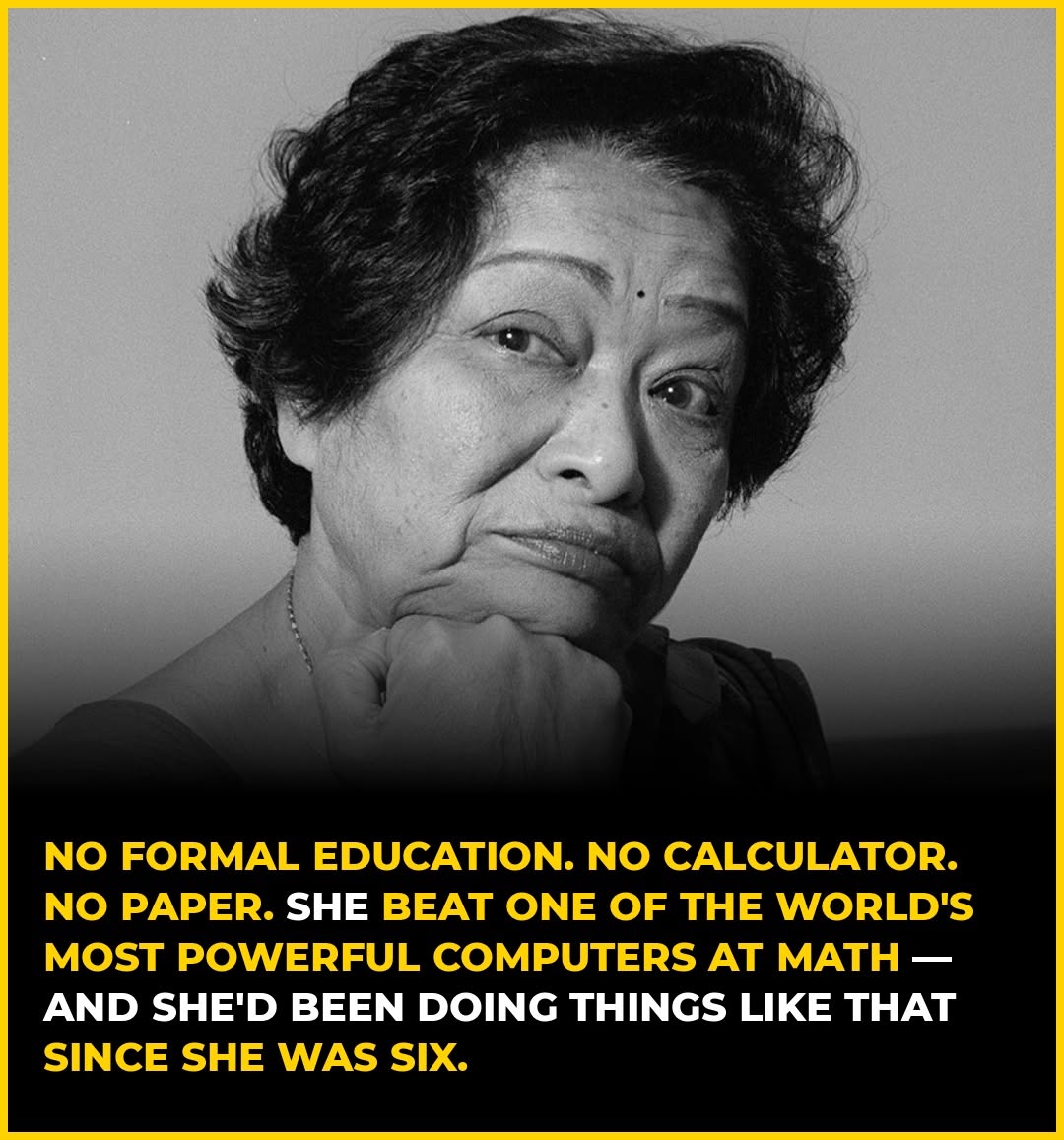

The Kannada Brahmin family Shakuntala Devi was born into had been priests for generations — it was what you did, what you became, the path laid out before you. Her father chose differently. He walked away from the temple and joined the circus instead, becoming a tightrope walker, trapeze artist, lion tamer, and stage magician.
He brought his daughter along.
It was in the circus — surrounded by card tricks and sleight of hand and the performance of impossible things — that a three-year-old girl named Shakuntala began doing something that nobody in her family had ever done before:
She started calculating.
Her father noticed it first during card tricks. He would show her a trick, and she would tell him how it worked — not by magic, but by mathematics. By the numbers on the cards, by the patterns in the sequences, by something that seemed to happen automatically in her mind between seeing a problem and knowing the answer.
Nobody had taught her. She had no formal education. She had no schooling at all, in fact — she would never have any. What she had was a mind that treated numbers the way most people treat words: naturally, instinctively, without effort, the way you recognize a friend’s face without consciously analyzing its features.
By the time she was six years old, Shakuntala Devi was performing public mathematical demonstrations.
And she had become the sole breadwinner of her family.
A six-year-old child, supporting her parents through the sheer force of her mathematical ability — performing at universities, at institutions, at public gatherings where people came to see something they couldn’t explain. She stood in front of crowds and solved problems that professors struggled with. She gave her first major show at the University of Mysore at age six.
She was a verified mathematical prodigy whose mind-boggling calculation speeds earned her a spot in the Guinness Book of World Records and the lifelong nickname of the “Human Computer”. [1, 2, 3]
While her historical feats are fully verified, public confusion often stems from how certain personal details were altered or debated in the 2020 Bollywood biopic starring Vidya Balan. [1, 2]
The Fully Verified Math Feats
Her most famous milestones are historical facts, heavily documented by international media and universities: [1, 2]
- The Guinness World Record (1980): At Imperial College London, she was asked to multiply two randomly selected 13-digit numbers (7,686,369,774,870 × 2,465,099,745,779). She spoke the correct 26-digit answer in just 28 seconds. This included the time it took her to physically speak the numbers. [1, 3]
- Outperforming a Supercomputer (1977): At Southern Methodist University in Dallas, she extracted the 23rd root of a massive 201-digit number in 50 seconds. It took a Univac 1101 computer 62 seconds to confirm her answer was right. [1]
- Correcting the BBC (1950): During a live BBC television broadcast with host Leslie Mitchell, she provided an answer to a complex math problem. The host told her she was wrong because her answer didn’t match their notes. After engineers rechecked the math, they realized the computer calculation was wrong, and Shakuntala was correct. [, 2, 3]
What the Biopic Changed (The Controversies)
When her life was adapted into a movie, several real-life events were altered or dramatized, leading people to wonder what was true: [1]
- Her Husband’s Sexuality: In 1977, Shakuntala Devi wrote The World of Homosexuals, which is historically recognized as the very first academic study of homosexuality in India. In real life, she stated her interest in the topic began because her husband, Paritosh Banerji, was a closeted gay man. However, the 2020 movie twisted this, portraying a scene where she lied about his sexuality just to sell more books—a change that drew heavy criticism from historians and LGBTQ+ advocates for being inaccurate and homophobic. [1, 2, 4, 5]
- Her Relationship with Her Daughter: The movie frames Shakuntala as an overbearing mother who frequently fought with her daughter, Anupama. While they had a complex relationship due to Shakuntala’s constant global touring, family acquaintances note the movie over-dramatized their estrangement for theatrical effect. [1, 2, 3, 5]
Other True (But Lesser-Known) Facts
- No Formal Education: Because her father was a poor circus performer who discovered her talent through card tricks at age three, she never received regular schooling. Her brain simply processed numbers naturally. [1, 2, 3, 4, 5]
- Political Run: In 1980, she actually ran for a seat in the Indian Parliament (Lok Sabha) as an independent candidate, directly contesting against the former Prime Minister Indira Gandhi (she lost, gaining less than 2% of the vote). []

