
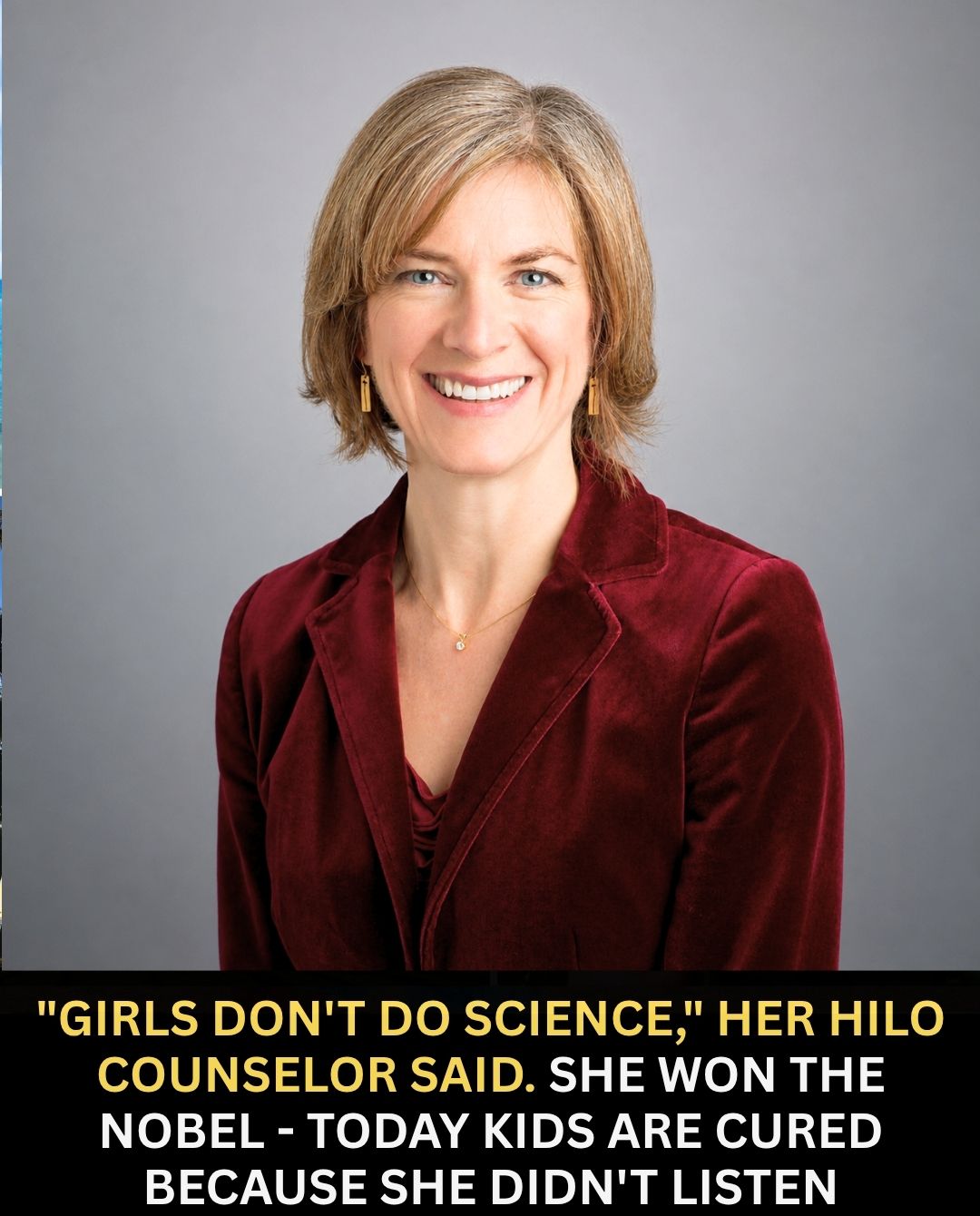

A high school counselor told her girls don’t do science. She grew up to rewrite the code of life.
She wasn’t born here. She moved to Hilo at seven years old, in the summer of 1971, when her father took a job teaching at the university. Most of her classmates were Hawaiian and Asian. She was the fair-haired, blue-eyed kid who stuck out like a sore thumb, the one who didn’t fit.
“Growing up as a haole (Hawaiian slang for a non-native), I felt really alone and isolated at school,” she said.
So she went outside instead. The Big Island raised her. She crawled through lava-flow caves and walked the forests of an island that held volcanoes and rainforest and beaches all at once, and she started asking the one question that would run the rest of her life. How did all of this come to be?
Then one day in the sixth grade, her father laid a used paperback on her bed. It was called The Double Helix, the story of the race to discover the shape of DNA. She read about a scientist named Rosalind Franklin, whose photographs cracked the structure wide open, and something shifted in the lonely Hilo girl that her counselor never saw coming.
A woman could be a great scientist.
She hadn’t known that was allowed.
She left Hilo in 1981 and chased the deepest puzzle she could find. How does a living thing read and edit its own instructions? In 2012, working with a scientist named Emmanuelle Charpentier, she cracked it. They took a trick that bacteria use to fight off viruses and turned it into something no human had ever held. A pair of molecular scissors you could program. Point it at one misspelled letter buried among three billion, and cut.
It meant you could fix the typo that gives a child sickle cell, or erase an inherited death sentence before it ever went off. The paper came out on June 28th. Almost no one noticed.
Eight years later, the phone rang from Sweden. In October 2020, Jennifer Doudna and Emmanuelle Charpentier won the Nobel Prize in Chemistry, the first two women ever to share it. “I couldn’t, in a million years, have ever imagined this moment,” she said.
But here is what almost no one understood about that prize. The same scissors that could cut out a disease could cut ANYTHING. A trait. An eye color. Someone’s private idea of a “better” human.
You could edit a person before they were ever born. And every cell of every child they had would carry it. FOREVER.
It could cut out a disease. It could cut out a difference. It could cut out anyone somebody decided didn’t belong.
Doudna knew it, and it started showing up in her sleep. She had a nightmare she NEVER shook, where a powerful man kept demanding she explain exactly how the tool worked. In the dream, it was Hitler. She woke up cold.
What have I done?
Then it stopped being a dream. On Thanksgiving Day in 2018, an email landed in her inbox. A scientist in China had taken the tool she helped unleash and used it, in SECRET, on two baby girls, editing them as embryos before they drew a single breath. The first gene-edited humans who ever lived. And no one had asked them.
“I was just horrified,” Doudna said. “I felt kind of physically sick.”
The tool she built to end suffering had been used to rewrite two children who never got a say. And she could not take it back.
She could rewrite the code of life. She couldn’t rewrite what we’d do with it.
So she did the thing scientists almost never do. She stood up and pumped the brakes on her own invention, demanding limits before it became a weapon.
And here is the part that should stop you. While she fought to keep the tool from doing harm, it was quietly becoming a miracle.
In 2019, a young mother named Victoria Gray became the first person cured of sickle cell disease with the tool Doudna built. Her whole life, her own blood had attacked her with pain that put her in the hospital over and over. The edited cells went in. The pain stopped. She said it let her “dream again without limitations.”
In December 2023, that treatment got a name, Casgevy, and became the first CRISPR medicine approved in America. Twenty-nine of the thirty patients in the trial went from a lifetime of pain crises to none.
A counselor in Hilo once told a lonely girl that people like her don’t do science. She didn’t argue. She handed the rest of us the power to edit the very thing that makes us human, then spent her life making sure we use it with mercy. The kid who never felt like she belonged grew up holding the question of who does.
And the Hilo girl is still awake at night, making sure we get the answer right.
Where is she Today
Jennifer Doudna is based in Berkeley, California, where she continues her pioneering work in gene editing.
She is a Professor of Chemistry and Molecular and Cell Biology at the University of California, Berkeley and serves as a faculty scientist at the Lawrence Berkeley National Laboratory. The 2020 Nobel Laureate remains one of the world’s most active and influential figures in biotechnology.
Her Current Leadership Roles
- Innovative Genomics Institute (IGI): Doudna serves as the founder and president of the Innovative Genomics Institute, a high-impact research partnership between UC Berkeley and UCSF focused on affordable medicine and agricultural solutions.
- Gladstone Institutes: She is a Senior Investigator at the Gladstone Institutes in San Francisco, leading a laboratory dedicated to mapping disease mechanisms.
- Howard Hughes Medical Institute: Doudna continues her long-standing appointment as an investigator for the Howard Hughes Medical Institute (HHMI).
What She Is Currently Doing & Researching
Doudna’s professional focus has shifted from the initial discovery of CRISPR-Cas9 to solving its modern real-world challenges:
- Bespoke, Scaling Real-Time Cures: Her current research explores scaling personalized CRISPR therapies. This includes developing “bespoke” treatments for rare, fatal genetic conditions in children—using validated lipid nanoparticles to fix genetic defects in real-time.
- Microbiome and Planetary Health: Her lab is engineering CRISPR tools to precisely edit entire communities of microbes (microbiomes). This research extends to climate change, including current projects aimed at altering cow gut microbes to drastically reduce livestock methane emissions.
- Recent Major Recognition: She was awarded the 2026 Priestley Medal, the highest honor given by the American Chemical Society (ACS), for her ongoing contributions to RNA chemistry, and was elected to the National Academy of Engineering class of 2026.

