
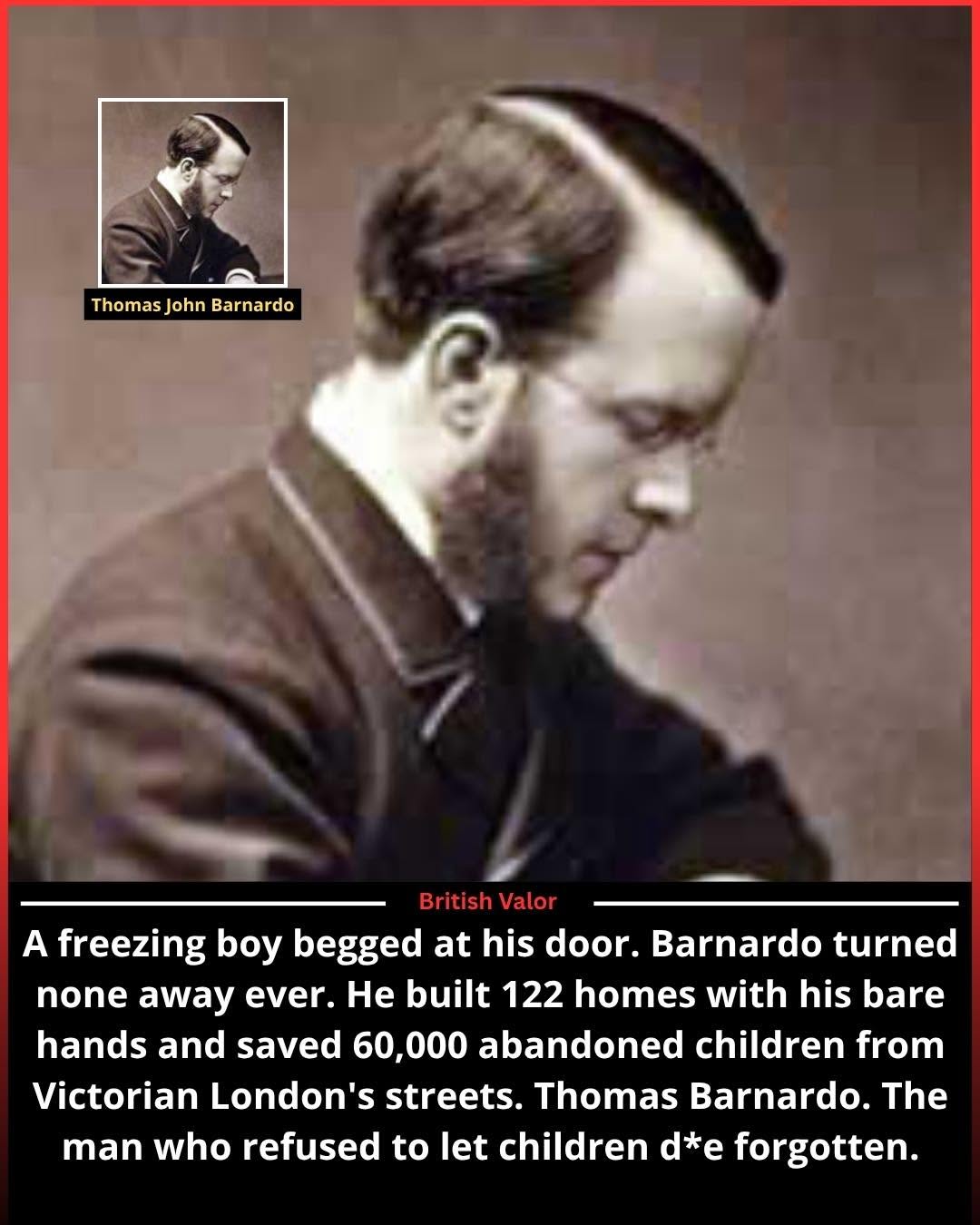

Born in Dublin in 1845, he moved to London and became one of the Victorian era’s most famous social reformers. He founded Barnardo’s, a major children’s charity that still operates across the UK.
In the filthy, fog-choked slums of Victorian London, children weren’t just poor they were invisible. They slept in doorways, starved in gutters, and di*d before anyone even learned their names. The world walked past them every single day.
Thomas John Barnardo refused to.
When a young ragged boy named Jim Jarvis led Barnardo through the freezing East End one bitter night, showing him rooftop after rooftop covered in homeless, shivering children something inside this young Irishman broke open forever. He didn’t write a letter to Parliament. He didn’t hold a meeting. He opened his door.
From that single act of human decency grew 122 children’s homes. Over 8,500 children were housed at the time of his de*th alone. By the end of his life, nearly 60,000 abandoned souls had been taken in, fed, educated, and given a fighting chance purely because one man decided that no child should be turned away. Ever. Not one.
He called it his golden rule. And he never broke it.
Thomas John Barnardo didn’t just build homes. He built futures for the children Victorian Britain had thrown away.
A true British hero. Never forgotten.
What is Fact
- The Core Mission: Barnardo genuinely dedicated his life to rescuing destitute street children in London’s impoverished East End. By the time he died in 1905, his organization had taken in nearly 60,000 children, providing them with housing, education, and trade skills. [1, 2]
- “No Destitute Child Refused”: His famous motto was born out of tragedy. In 1870, an 11-year-old homeless boy named John Somers (nicknamed “Carrots”) was turned away from Barnardo’s shelter because it was completely full. Two days later, the boy was found dead from malnutrition and exposure. Moving forward, Barnardo vowed never to turn a child in need away again. [1, 2, 3, 4, 5]
- Pioneering Foster Care: Influenced heavily by caring for his own daughter, Marjorie, who had Down syndrome, Barnardo became an early pioneer of modern foster care. In 1887, he introduced “boarding out”—placing vulnerable children with supportive host families rather than keeping them in large, institutional orphanages. []
What is Myth or Controversy
While his charitable impact was real, Barnardo was a highly flawed and aggressive figure who frequently bent the truth to secure funding: [1, 3]
- The “Doctor” Lie: He was universally known as “Dr. Barnardo,” but he was not a registered medical doctor. He entered medical school in London to train as a missionary, but he dropped out to run his charity and simply appropriated the title to gain prestige and trust. [1, 2]
- Staged Photography: Barnardo was a master fundraiser who heavily utilized photography. However, he was caught “staging” before-and-after photos of street children—making them look deliberately dirtier, more ragged, and more miserable than they actually were when he found them—to shock wealthy donors into giving money. [1, 2, 3, 4, 5]
- The “Home Children” Scheme: One of the darkest aspects of his true story is child emigration. Barnardo’s charity sent an estimated 30,000 British children to Canada and Australia to work as farm hands or domestic servants. While framed as a chance at a fresh start, many of these “Home Children” were separated from their families without parental consent and faced severe isolation, exploitation, and abuse. [1, 2, 3, 4]


