
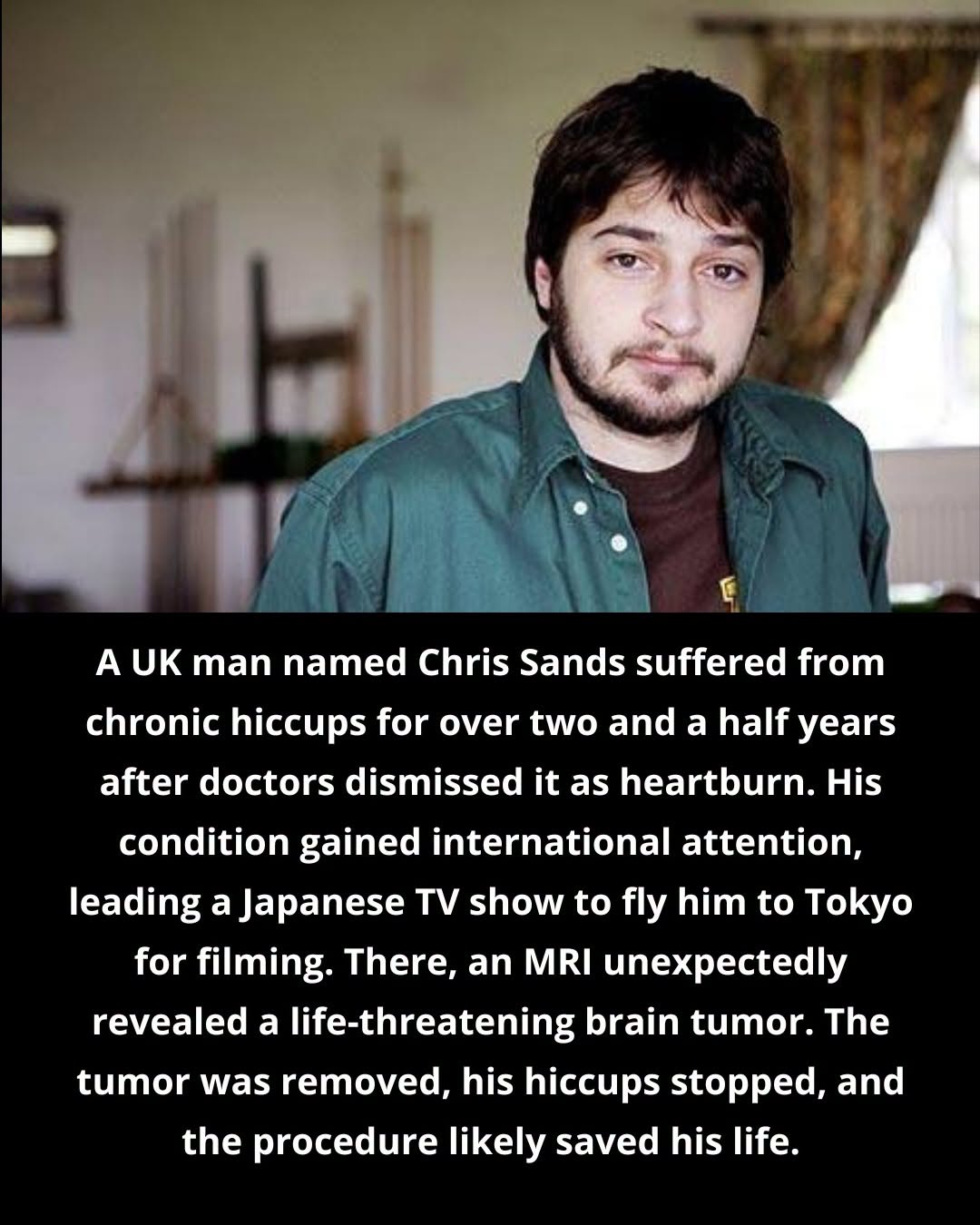

In September 2006, Chris Sands began hiccupping. The spasms came every two seconds, sometimes for 14 hours straight, and didn’t stop for over two and a half years.
He tried everything—yoga, hypnotherapy, and even eating honey while hanging upside down—but nothing worked. His local doctor told him it was “probably just heartburn” and prescribed antacids.
After a desperate online appeal, a Japanese TV show flew him to Tokyo, where a doctor performed an MRI and discovered a tumor on his brain stem.
Surgeons removed 60% of the tumor, and his hiccups stopped. The episode that might have killed him was caught just in time.
Chris Sands is completely cured, hiccup-free, and has successfully returned to his passion for music. [1, 2, 3]
After his extraordinary case made global headlines, his life underwent a drastic turn that ultimately saved him. [1, 2, 3]
The Long-Awaited Cure
Between 2006 and 2009, Chris Sands suffered from chronic hiccups that struck every two seconds for up to 14 hours a day. The relentless condition robbed him of his sleep, weight, and ability to sing or work. [1, 2, 3]
Following an appearance on a Japanese documentary, doctors finally discovered the root cause: a tumor on his brain stem. In September 2009, he underwent a complex, life-saving surgery that removed 60% of the tumor, instantly curing his hiccups. [1, 2]
His Life Today
- Return to Music: Before the condition took over, Chris was an aspiring musician and the guitar player/backing vocalist for his punk band, Ebullient. Though the surgery temporarily impacted the motor skills on his left side, he underwent months of rehabilitation and successfully learned to play the guitar again. He has since returned to jamming and practicing with his band. [1, 3, 4, 5]
- Living Normally: Today, Chris is able to hold down a job, live independently, and eat and sleep without the constant agonizing threat of diaphragmatic spasms. [1, 2]
- Advocacy: He has occasionally shared his medical journey to raise global awareness about how chronic hiccups can be a vital warning sign for larger, underlying neurological or cardiovascular conditions
The Japanese team discovered Chris Sands’ tumor by administering an MRI scan—a specific diagnostic test his doctors in the UK had never ordered. [1, 2]
The discovery unfolded through a series of unusual events:
A Viral Cry for Help
By 2008, Chris had been hiccuping for over two years. Desperate for answers, he posted YouTube videos documenting his agonizing condition, which caught the attention of a Japanese variety television program. Because the show received 400 to 500 different home remedies from viewers, the producers offered to fly Chris to Tokyo to try them out for a televised segment. [, 2, 3, 4, 5]
Meeting a Hiccup Specialist
Within three hours of landing in Tokyo, Chris was introduced to Dr. Tatsuya Kondo (frequently referred to as Dr. Condo in UK media) at Juntendo University, a specialist who had been studying the mechanics of hiccups for 15 years. [1, 2]
The Diagnostic Breakthrough
Unlike the UK doctors who repeatedly dismissed Chris’s condition as standard acid reflux or heartburn, Dr. Kondo immediately understood the neurological connection to chronic spasms. He ordered an MRI (Magnetic Resonance Imaging) scan. [1, 2, 3, 4]
The scan revealed a 1.2-centimeter tumor growing directly on Chris’s brain stem. [1]
Why Had It Been Missed?
Chris had previously undergone standard CT scans in England, which came back clear. Dr. Kondo later explained that CT scans are notoriously poor at detecting anomalies on the brain stem. Because the brain stem houses the pathways for the phrenic nerve—which controls the diaphragm—the tumor was constantly compressing the nerve, triggering the hiccups. Only the high-contrast imaging of an MRI could catch it. [1, 2, 3, 4, 5]


